Oct 1, 2026Product News
From Your Idea to a Finished Product: How Mattzon Develops New Products Around Customer Requirements
From first phone call to mass production: how Mattzon's OEM/ODM process turns a customer requirement into a certified, private-mold USB accessory — with real timelines, testing steps and a case study.
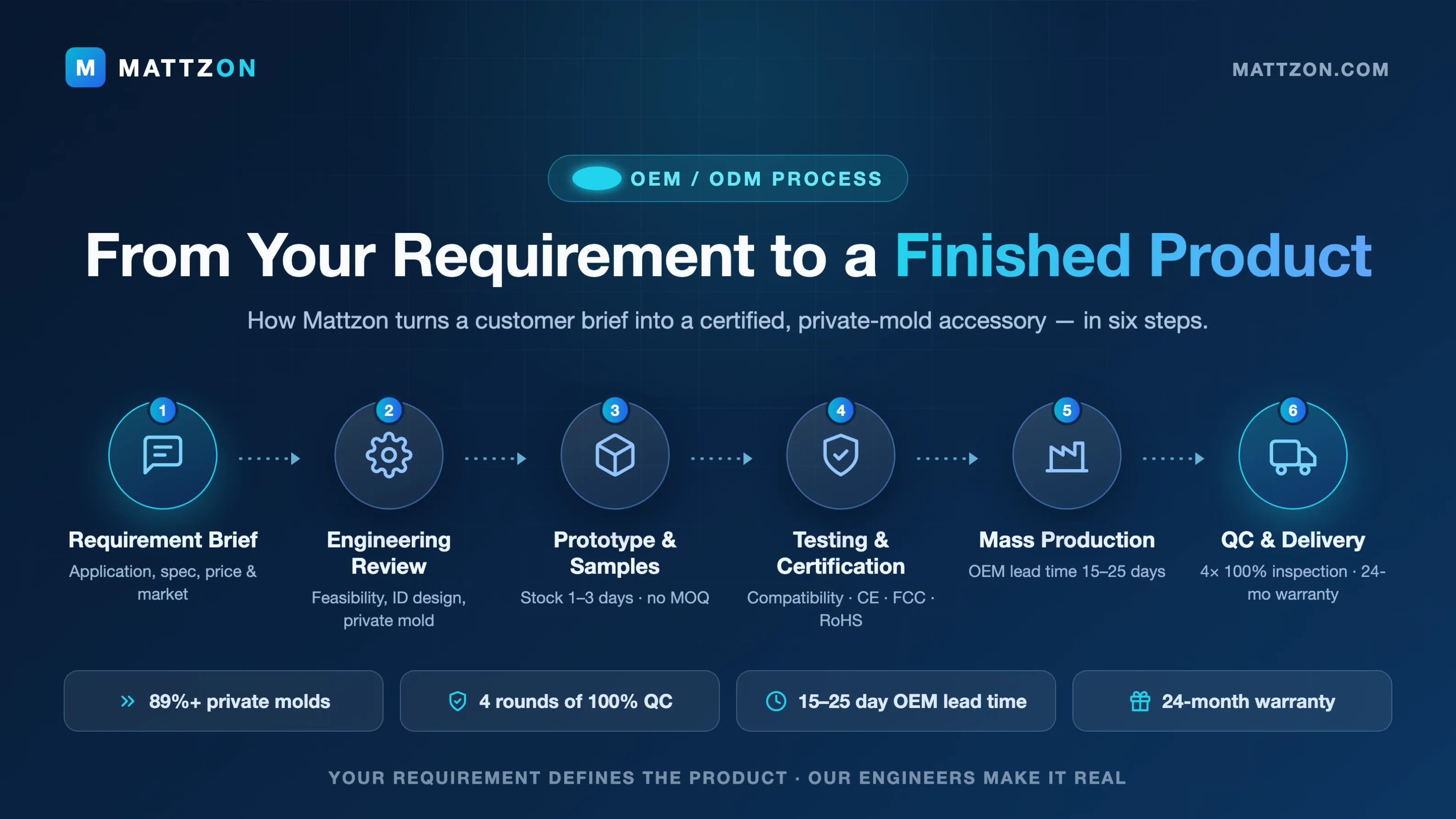
Every catalog product in our factory started the same way: a customer described a problem, and our engineers went to work. As a Shenzhen-based manufacturer of USB-C hubs, docking stations, cables and card readers with more than a decade of OEM/ODM experience, product development driven by customer requirements is not a side service for us — it is how most of our range was born.
Here is a transparent look at how the process works, step by step, so you know exactly what to expect when you bring us an idea.
Step 1: We start with your requirement, not our mould library
Development begins with a conversation. A typical brief covers:
- The application. Who uses the product, on which devices, in which environment — a travel hub for a business laptop is a very different machine from a desk dock for a dual-monitor trading station.
- The specification. Ports, data speed, power delivery wattage, display output, materials, cable length, dimensions and weight targets.
- The market. Which countries you sell in (this decides CE, FCC, RoHS, REACH or other certifications), which retail channel, and your target price band.
- The branding. Logo placement, packaging design, and whether you need an exclusive private mold or a customized version of an existing platform.
At this stage many clients arrive with nothing more than a sketch, a competitor's sample, or a sentence like "our customers keep asking for a card reader that also charges the laptop." That is enough to start.
Step 2: Engineering feasibility and industrial design
Our engineering team — Foxconn-trained, with over ten engineers on staff — reviews the brief for technical and cost feasibility, usually within a few days. This is where the hard questions get answered early: Can the power budget support three ports plus 100W passthrough in that housing? Is the chip solution available at the target price? Does the thermal design need aluminum?
Because 89%+ of our products are built on private molds, we can often propose modifying an existing platform instead of cutting a new mold — which saves clients months and significant tooling cost. When a fully custom design is needed, we handle industrial design, 3D structural drawings and mold fabrication in-house with our long-term molding partners.
Step 3: Prototyping and samples — fast, and without MOQ
Once the design is locked, we produce functional prototypes and 3D-printed appearance samples for approval. Stock-model samples ship in 1–3 days; custom OEM samples typically within two weeks. We do not impose a minimum order quantity for sampling, because we would rather let the product earn your order than force one.
Good prototypes answer the questions renderings cannot: how the ports feel when a plug is inserted, whether the cable strains at the joint, how warm the housing runs under full load.
Step 4: Testing — compatibility first, certification second
This is the stage that separates professional factories from trading companies. Every new design goes through:
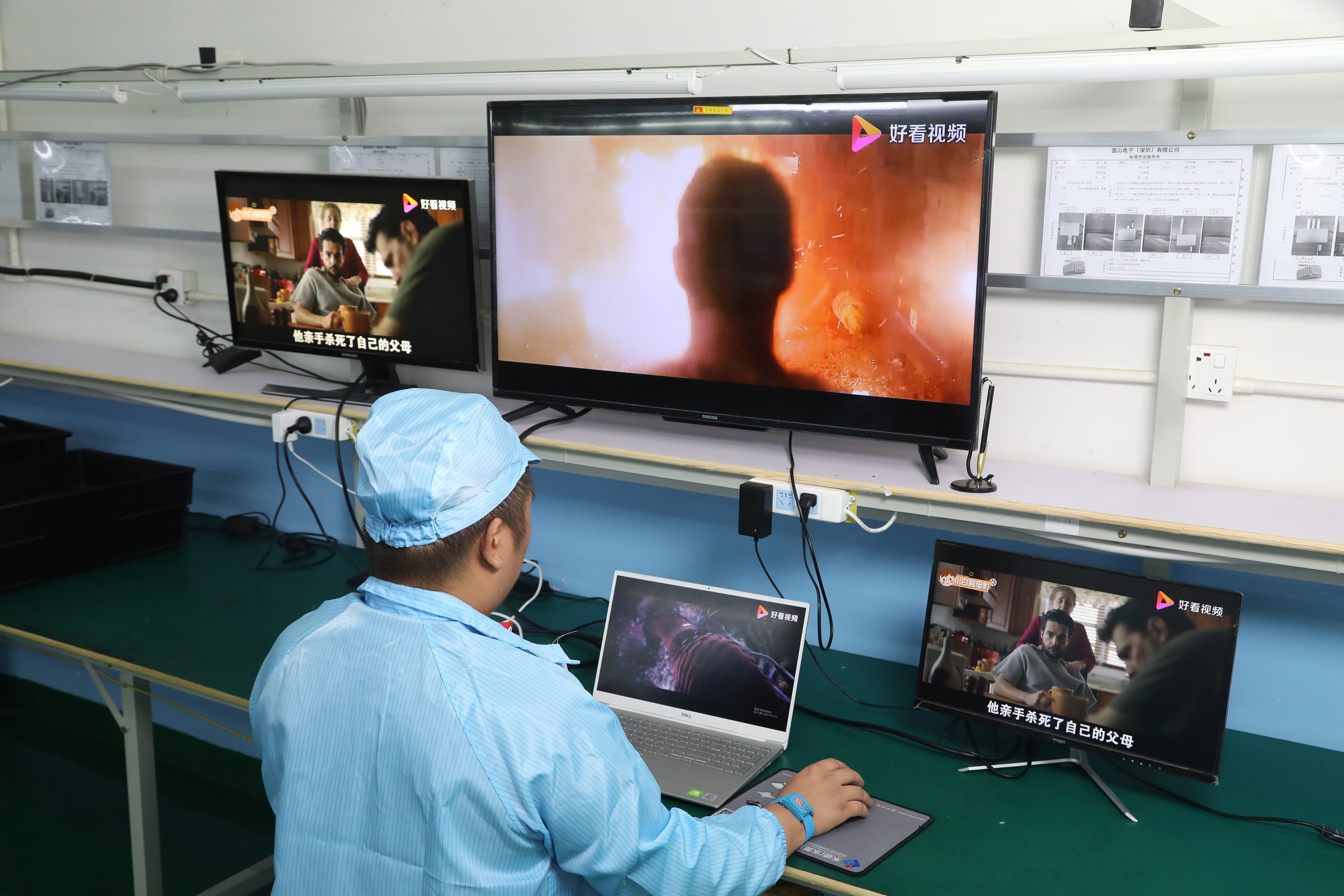
- Device compatibility testing. Hubs and docks are verified against real laptops and phones across brands — Windows, macOS, iPadOS, Android — including the awkward combinations: phones that negotiate power differently, monitors that flicker on marginal DP links, cards formatted in cameras.
- Performance and reliability testing. Data throughput under sustained load, PD voltage stability, plug/unplug endurance on connectors and cables, drop and salt-spray tests on housings.
- Compliance certification. CE, FCC, RoHS and REACH reports through accredited third-party labs, arranged per your destination market.
Any failure sends the design back to engineering — not forward to your container.
Step 5: Pilot run, mass production and four rounds of inspection
After sample sign-off, we run a small pilot batch to validate the production line, then move to mass production with a standard OEM lead time of 15–25 days. Quality control is not a final gate but a system: every order passes four rounds of 100% full inspection — incoming materials, inline production, post-assembly, and pre-packaging — before anything is sealed into a carton.
A real example: a card reader born from a customer brief
Last year a European distributor of photography accessories came to us with a familiar complaint: video shooters using Sony mirrorless cameras were forced to carry two or three separate readers — one for CFexpress Type A cards, one for the drone's microSD, plus a hub for their MacBook. Could we combine them without the usual plastic-hub feel?
The result is the MZTC9972: an aluminum USB-C card reader with a CFexpress Type A slot and a microSD 4.0 slot, plus three additional USB ports (USB-C and USB-A, up to 10 Gbps) on a 16 cm cable — a reader and mini-hub in one. The customer's logo went on the housing, the packaging was designed to their retail standard, and the product now anchors their winter catalogue. Two sister models followed for different price points: the MZTC9924 dual-slot SD 4.0 + microSD 4.0 reader and the entry-level MZTC923 2-in-1 reader.
That is the pattern we repeat every month: your requirement defines the product; our engineers, molds and lines make it real.
Ready to develop yours?
Whether you have a complete specification or just a problem worth solving, send it over.
Samples of stock models ship in 1–3 days, OEM projects run 15–25 days, and every product is backed by a 24-month warranty.
Reach us at info@mattzon.cn or WhatsApp +86 18681462886 — and let's turn your requirement into your next best-seller.