Oct 2, 2026Buying Guides
Sample vs Bulk: How to Audit a USB-C Hub Factory Before You Commit
Golden samples impress and bulk shipments disappoint, because quality drifts between the two. Here is a practical six-point audit that shows buyers exactly where to look before committing to a factory
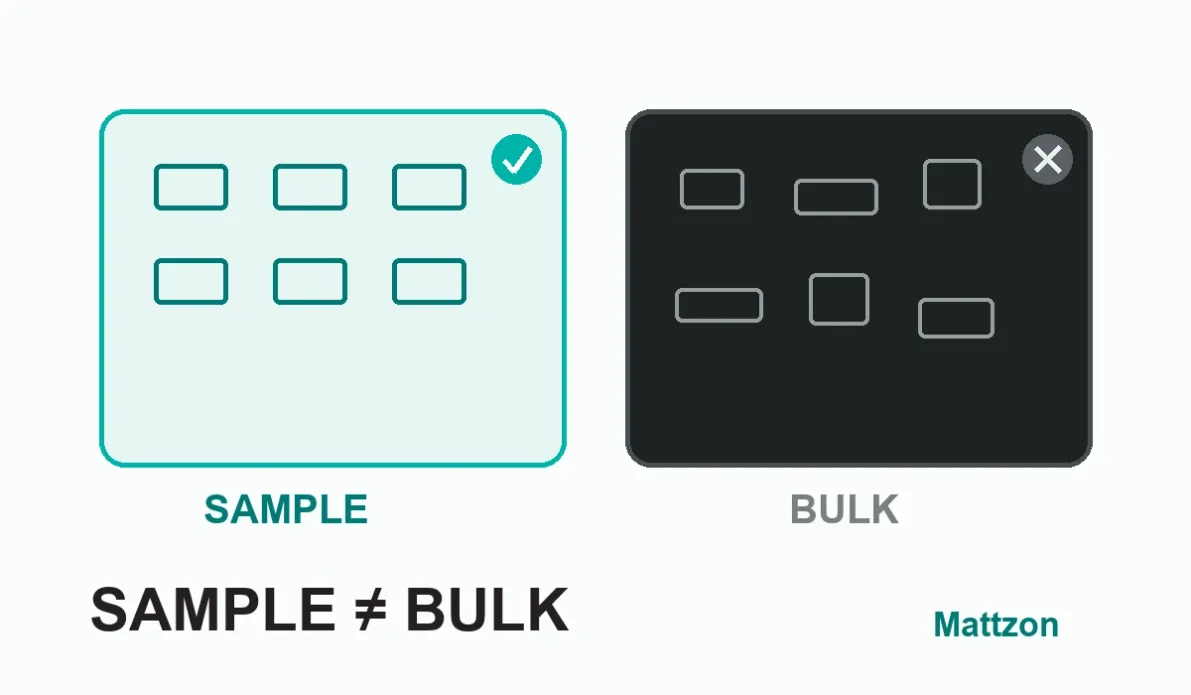
Every importer of electronics knows the two faces of the same factory.
Face one is the sample: built with selected components, checked personally, packed
neatly, arriving perfect.
Face two is the bulk order: same factory, same product name, but somewhere between the golden sample and the container, quality drifts. Units arrive with ports that feel loose, chargers that negotiate slowly, screws missing, serial numbers out of order. The product
looks identical and behaves worse.
Sourcing communities and procurement advisors have documented this pattern
for years, and it is the single most expensive lesson in consumer electronics
import: the sample proves the factory CAN build it right; it does not prove
the factory WILL build your next ten thousand the same way. The gap between
can and will is where margins go to die — in warranty returns, in rework at
the destination warehouse, and in the reviews that outlive both.
The good news is that this gap is auditable.
You do not need a lab or anengineering degree to spot the difference between a factory that controls its process and one that improvises. You need a checklist, an hour of honest
questions, and the discipline to walk away when the answers wobble. Here is
the six-point audit we suggest to any buyer, and the answers we give when
buyers run it on us.
Point one: ask what is actually in-house. A "factory" that outsources its
SMT placement, its assembly or its aging test does not control the two things
that drift first in bulk production — soldering quality and burn-in screening.
Every process handed to a subcontractor adds a place where your quality lives
overnight in someone else's hands. The answer you want is specific: SMT lines
on site, assembly on site, aging and per-port testing on site. When we say our
Shenzhen plant runs SMT, assembly and aging testing in-house, that sentence is
the whole point.
Point two: ask how a unit dies before it ships. Every factory produces a
certain number of marginal units — a weak solder joint, an out-of-tolerance
component. A serious factory catches them before packing: 100% per-port
functional testing and a timed aging test on every unit, not a sample of one
in fifty. Ask what the test covers and ask to watch it, live on a video call.
A factory that tests every port of every hub will put the test racks on camera
within a day. A trading company will start talking about "QC by inspection
report" — written by whom, based on what?
Point three: seal the golden sample, then demand a first-article check from
the actual bulk run. The golden sample you approved should be the reference,
and the first units off the bulk line should be compared against it — same
components, same weight, same feel, same test results. This practice, called
first-article inspection in the industry, costs nothing and catches drift
while it is still measured in units rather than pallets.
Point four: ask where the components come from in bulk, not in samples. The
classic drift in hub and cable production is substitution: the sample used a
brand-name power chip; the bulk run uses whatever the market offers that week.
You do not need to police part numbers yourself — you need a supplier who
commits to a bill of materials in writing and flags any substitution before
it ships, not after you find it.
Point five: start with a pilot batch, and judge it like an end user. Pull ten
units at random from the pilot. Plug, unplug, charge, connect a display, read
a card, run them warm. Count how many feel like your golden sample. A factory
confident in its process makes this easy — which leads to the structural
point: minimum order quantity. A supplier demanding a 5,000-unit commitment
before you can test their consistency is asking you to finance their risk.
When a factory offers no MOQ, samples to evaluate and 3-to-25-day lead times,
it is telling you something about how its bulk quality survives contact with
small, repeatable, judgeable batches.
Point six: ask what happens after something does slip. No process is perfect;
the question is whether the factory's response is disciplined — a written
8D-style answer (what happened, what root cause, what changes so it cannot
recur) — or a discount coupon. Suppliers who answer claims with analysis keep
accounts for a decade. Suppliers who answer with a refund keep sending samples.
Run these six points on any supplier, including us. At Mattzon we invite
OEM and ODM buyers to audit exactly this way: video walk-throughs of the SMT
line, assembly and aging racks on camera, per-batch inspection reports with
every shipment, a sealed golden sample and first-article checks on bulk runs,
and true no-MOQ trial orders so the audit costs you a sample fee instead of a
container deposit. Eighty-nine percent of our products are private mold, built
in our own 5,700-square-meter plant in Longgang, Shenzhen.
The sample earned you the meeting.
The audit earns you the supplier.
If you want to see our process before your next hub or cable order, message Kitty's
team on WhatsApp at +86 186 8146 2886, bring your checklist, and we will put
every answer on camera.